

Heat Treatment of Metals and Alloys

Metal Heat Treatment: Professional Services from the KARBAZ Heat Treatment Center
Heat treatment is a sequence of operations involving heating solid metals and their alloys to a specified temperature, holding them at that temperature, and cooling them at a specified rate.
The purpose of heat treatment is to obtain the required mechanical and physical properties — such as improved machinability or increased or reduced hardness and strength — by changing the internal structure of metals and alloys without changing the product shape or chemical composition.
Heat treatment may be used as an intermediate operation (preliminary heat treatment) to improve formability or machinability and relieve stresses, or as a final operation in the process route to provide the required level of product properties.
When a component fails under working load or cracks during grinding, the cause is often related to incorrect temperature regimes. Metal heat treatment is a controlled technological process that involves heating, soaking, and cooling the material according to strictly defined parameters. This changes the alloy’s crystal structure and can substantially improve strength, wear resistance, and other service properties.
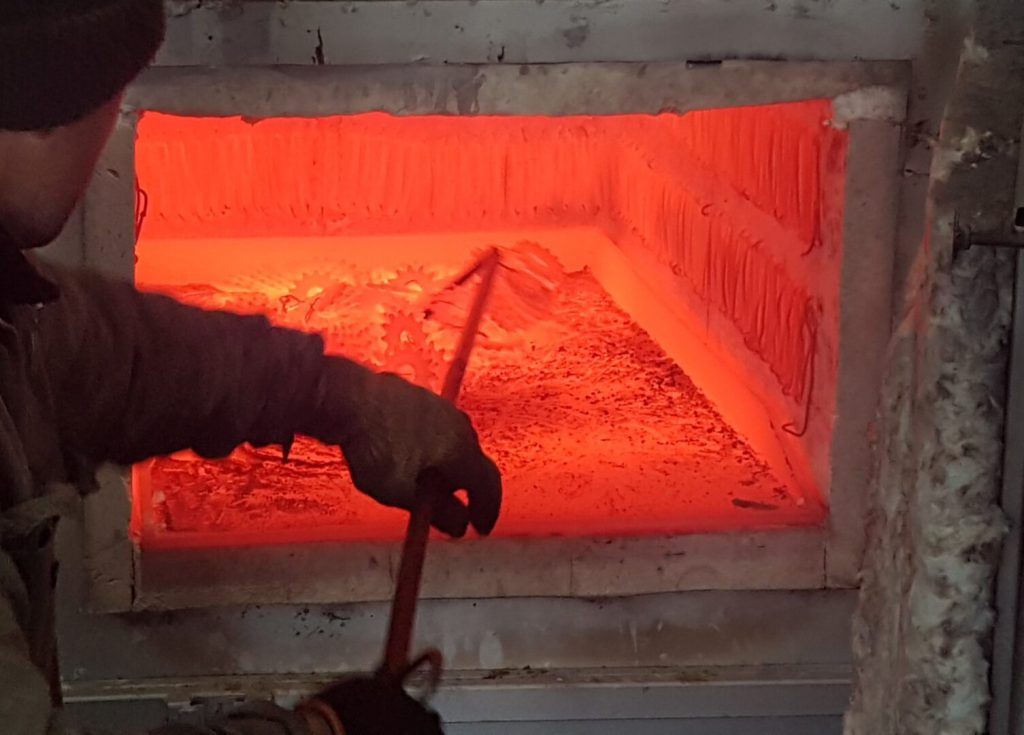
KARBAZ provides professional heat-treatment services using its own certified equipment.
We act as a reliable technology partner:
- we start with the customer’s request and the necessary process consultation;
- we then prepare a technical specification based on drawings, sketches, or a description of technical requirements;
- we receive your blanks or finished parts;
- we perform the required processing and quality-control operations;
- finally, you receive treated products with the specified set of properties and the corresponding quality certificate.
The parameters of each heat-treatment cycle are selected individually for the customer’s specific task.
Comprehensive heat treatment at our facility is used to solve a number of critical engineering tasks:
- Substantially increasing service strength, surface hardness, and wear resistance of highly loaded components.
- Improving material machinability or formability at intermediate production stages.
- Fully relieving internal stresses in metal after welding, forging, or rough milling.
Our services are intended for large and small machine-building companies, manufacturers of tools, molds, and dies, repair and agricultural companies, as well as private customers who need a predictable result. We accept blanks and finished parts made from various steel grades, cast iron, and non-ferrous alloys, and aim to ensure that properties — including microstructure — match the design documentation.
Why Heat Treatment Is Needed
The main reason to order metal heat treatment is to change the material’s properties without altering the shape or geometry of the part. The process takes place within the alloy’s internal structure under precisely controlled temperature conditions. This makes it possible to control product characteristics: achieve the required hardness, increase strength and wear resistance, restore ductility, or significantly improve subsequent machining.
Professional heat treatment can be used to address the following tasks:
- Achieving the specified hardness and strength in accordance with working drawings.
- Increasing ductility and toughness to reduce the risk of brittle failure under impact loads.
- Stabilizing part dimensions over time by relieving structural stresses.
- Preparing rolled products or forgings for subsequent finish milling or turning.
Depending on the designed process route, heat treatment may serve as an intermediate stage that facilitates further machining of the blank or as a final operation that defines the component’s final service properties.
Types of Heat Treatment We Perform
The KARBAZ engineering center performs the main types of heat treatment and chemical heat treatment using modern industrial equipment. Our materials specialists select the optimal method based on alloy grade, part configuration, hardness requirements within +/- 2 HRC, and future operating conditions.
| Type of treatment | Purpose | Typical parts |
|---|---|---|
| Annealing | Relief of internal stresses, reduction of hardness, increase in ductility and toughness, correction of coarse-grained structure after casting or forging, and improved machinability. | Forgings, cast blanks, welded structures, forming tools before final processing, shafts, gears (preliminary stage). |
| Normalizing | Grain refinement, relief of internal stresses, reduction of chemical non-uniformity (segregation), homogenization of the structure, and improvement of mechanical properties before hardening or as a final treatment for low-carbon steels. | Large forgings, welded assemblies, rolled products, shaped castings, gear blanks, axles, connecting rods. |
| Austenitizing (austenite hardening) | Transformation of austenitic and corrosion-resistant (stainless) steels and alloys into a single-phase austenitic state, followed by fixing carbide dissolution to provide maximum corrosion resistance, ductility, and non-magnetic properties. | Parts made of austenitic stainless steels (e.g. 12Kh18N10T, AISI 304, AISI 316), chemical-equipment fittings, non-magnetic rings, pipes, heat exchangers. |
| Hardening | Achieving maximum hardness, strength, wear resistance, and a high elastic limit by forming a martensitic structure during rapid cooling from the austenitic range. | Gears, gear wheels, gear shafts, spindles, axles, bearings, springs, cutting and forming tools. |
| Isothermal hardening | Formation of a bainitic structure that combines high strength with increased impact toughness, crack resistance, and minimal distortion and residual stresses. | Highly loaded gears, critical springs and leaf springs, complex-profile parts, high-strength ductile iron (ADI). |
| Hardening in protective atmospheres | Hardening in vacuum or in controlled/inert gases (endogas, nitrogen, argon) to prevent decarburization and surface oxidation while retaining dimensional accuracy and surface cleanliness. | Precision parts, molds, high-accuracy dies, critical tools, small components with finished surfaces. |
| Induction hardening / HF hardening | Surface strengthening of parts (formation of a hard, wear-resistant surface layer) while retaining a tough and strong core, minimizing distortion, and providing high productivity. | Crankshafts and camshafts, pins, gears (tooth hardening), crane wheels, machine-tool guideways, splines. |
| Tempering | Relief of hardening stresses, adjustment of the balance between strength, hardness, and ductility, and formation of the required service properties (low, medium, or high tempering / quench-and-temper treatment). | All hardened parts: tools (low tempering), springs and leaf springs (medium tempering), critical shafts and gears (high tempering). |
| Aging | Final strengthening after solution treatment (precipitation hardening) through precipitation of fine phases in non-ferrous alloys (aluminum, titanium) and in some stainless and heat-resistant steels. | Parts made of aluminum alloys (D16, V95), titanium alloys, and precipitation-hardening stainless steels (17-4PH, 07Kh16N6) for aerospace and precision engineering. |
The heat-treatment method is selected individually for each product. Our materials engineers consider the steel grade, drawing requirements, component purpose, required hardness, and future operating conditions in the mechanism. Exact heating parameters, soaking time, and cooling rate are calculated and assigned by a process engineer only after a detailed review of all technical requirements.
Our technical capabilities
for heat treatment
The company’s extensive equipment base and the qualifications of its materials engineers allow it to work with a wide range of part sizes and weights. We currently provide the following capabilities for both production batches and individual orders:
- Annealing, normalizing, austenitizing, air hardening, tempering, and aging — small parts are processed in chamber furnaces, while large parts are processed in shaft furnaces; diameter up to 1000 mm, length up to 4000 mm, and total weight up to 5 tonnes.
- Oil hardening — from small parts up to 20–30 kg in chamber furnaces to large parts up to 1000 mm in diameter, 3000 mm in length, and 1500 kg in weight in large shaft furnaces.
- Hardening in a non-oil quenching medium (polymers and the company’s proprietary know-how quenching medium) — small parts up to 20–30 kg and large parts up to 1000 mm in diameter, 4000 mm in length, and 5 tonnes in weight.
- Isothermal hardening in a salt bath — parts up to 500 mm in diameter, 1000 mm in length, and 50 kg in maximum weight.
- Induction hardening is performed on a modern 15–30 kHz, 120 kW unit for shafts up to 3.5 m long and gears or rings up to 2.5 m in diameter. A compact 100–300 kHz, 15 kW ultra-high-frequency system is also used for precision induction hardening of small, high-accuracy parts. Part parameters are confirmed individually for each case. The method is suitable where only local surface hardening is required, for example on gear teeth, splines, or shaft journals, without changing the properties of the core.
The customer receives a complete package of supporting documents and a technical passport for the batch, confirming process consistency and reducing the risk of hidden defects.
Our technical capabilities
for heat treatment
- Annealing, normalization, austenitization, air or water hardening, tempering, aging – parts with a diameter of up to 900 mm, length up to 1250 mm, and weight up to 2 tons.
- Oil hardening and non-oil quenching medium – parts weighing up to 100 kg.
- Hardening in salt bath furnace – parts with a diameter of up to 400 mm, length up to 450 mm, and weight up to 30 kg.
- Induction Hardening – furnace power of 120 kW. Processing parameters for parts are specified in each individual case.
Metals and Parts We Accept for Heat Treatment
Our production sites accept blanks and finished products made from most commonly used steel grades, as well as engineering cast iron, copper and its alloys (brass and bronze), aluminum, and other alloys after the technical specification has been reviewed with our specialists. Typical products we regularly process include:
1. Shafts, axles, and rotating components
- Crankshafts (hardening, induction hardening of journals, nitriding)
- Camshafts (hardening, induction hardening of cams)
- Turbine shafts (quench-and-temper treatment: hardening + high tempering)
- Drive and load-bearing axles (induction hardening, quench-and-temper treatment)
- Gear shafts (carburizing, nitrocarburizing, carbonitriding, hardening)
- Machine-tool spindles (nitriding, carburizing, induction hardening)
- Lead screws and worm shafts (carbonitriding/nitriding to minimize distortion)
- Marine propeller shafts (austenitizing for stainless steels, quench-and-temper treatment)
- Rolling-mill rolls (through hardening or surface induction hardening)
- Splined shafts (induction hardening, carburizing + hardening)
2. Gears and transmission components
- Spur and helical cylindrical gears (carburizing, carbonitriding, induction hardening)
- Bevel gears and hypoid pairs (carburizing + hardening)
- Ring gears (through hardening, carbonitriding, induction hardening of teeth)
- Double-helical gears (nitriding/carbonitriding, quench-and-temper treatment)
- Worm wheels (hardening of cast-iron or steel hubs)
- Gear racks (carbonitriding, induction hardening of teeth)
- Gear couplings and half-couplings (carburizing, nitriding)
- Chain sprockets (induction hardening)
- Internal ring gears of planetary gearboxes (nitriding, nitrocarburizing)
- Planet gears (carbonitriding, carburizing + hardening)
3. Bearing components and friction guideways
- Ball and roller bearing rings (martensitic or bainitic hardening)
- Bearing balls and rollers (through hardening, low tempering)
- Machine-bed guideways (surface induction hardening, nitriding)
- Telescopic guides for sliding systems (carbonitriding/nitriding, QPQ)
- Support rollers for conveyors and tracked systems (induction hardening)
- Highly loaded plain bushings (carburizing, nitriding, QPQ)
- Thrust washers and friction discs (carbonitriding, low tempering)
- Piston pins (carburizing, induction hardening)
- Press slides and rams (induction hardening, surface nitriding)
- Thrust bearings for hydro turbines and pumps (nitrocarburizing, nitriding)
4. Impellers, blades, and hydraulic/pneumatic units
- Steam and gas turbine blades (austenitizing, aging)
- Centrifugal pump impellers (annealing, austenitizing of stainless steels, induction hardening of hubs)
- Hydro-turbine blades (normalizing, quench-and-temper treatment for stress relief)
- Compressor discs (hardening + aging of titanium or heat-resistant alloys)
- Hydraulic plungers and pistons (carburizing, nitriding, QPQ)
- Vane-pump housings and rotors (carburizing, induction hardening)
- Blower and exhaust-fan blades (nitriding to improve erosion resistance)
- Mixer impellers for aggressive media (austenitizing of stainless steels)
- High-pressure injector valves and needles (nitriding, vacuum hardening)
- Hydraulic valve seats (carburizing, induction hardening)
5. Cutting tools
- HSS drills and counterbores (salt-bath hardening + multiple tempering)
- Slitting and end mills (hardening + tempering)
- Taps and threading dies (hardening, cyaniding/nitriding)
- Broaches and piercing tools (hardening in protective atmospheres, nitriding)
- Reamers (hardening, low tempering)
- Lathe cutting tools (hardening)
- Gear shaper cutters (hardening, nitriding)
- Paper, metal, and guillotine knives (hardening, medium/low tempering)
- Circular saws and segment saws (induction hardening of teeth, isothermal hardening)
- Woodworking cutters and planer knives (hardening, low tempering)
6. Forming and die tooling
- Plastic injection molds (hardening, nitriding/carbonitriding)
- Dies and punches for cold stamping (hardening, cryogenic treatment)
- Hot-forming/forging dies (hardening, medium tempering, nitriding)
- Extrusion dies for aluminum profiles (carbonitriding/nitriding)
- Pressure die-casting molds for aluminum and zinc (vacuum hardening, QPQ)
- Rolls for profiling and rolling sheet metal (carburizing, induction hardening, carbonitriding)
- Forging dies for hammers and presses (normalizing, quench-and-temper treatment, hardening)
- Heading punches for fasteners (isothermal hardening, hardening, carbonitriding)
- Gauges and measuring tools (plugs, snap gauges) (carburizing, hardening + cryogenic cooling for dimensional stabilization)
- Powder-compaction dies (hardening, carbonitriding)
7. Welded and large metal structures
- Welded beds of heavy machine tools and presses (high tempering to relieve welding stresses)
- Winch and crane drums (normalizing, induction hardening of grooves)
- Welded high-pressure vessels and autoclaves (high tempering/austenitizing)
- Special welded beams and trusses (normalizing, high tempering)
- Welded gearbox housings (stress-relief annealing)
- Welded high-pressure pipes and pipelines (through normalizing, local tempering of the weld)
- Welded sections (annealing/high tempering)
- Welded booms (quench-and-temper treatment, stress relief)
- Welded autoclaves and reactors for chemical production (austenitizing of stainless steels)
- Excavator buckets and bulldozer blades (hardening of overlaid wear-resistant elements made from 110G13 steel)
8. Springs, leaf springs, and elastic components
- Leaf springs (hardening + medium tempering)
- Vehicle suspension coil springs (hardening, medium tempering)
- Engine valve springs (isothermal hardening, medium tempering, nitriding)
- Suspension and drive-shaft torsion bars (induction or through hardening + medium tempering)
- Disc springs (isothermal hardening, medium tempering)
- Spring lock washers (hardening, medium tempering)
- Spiral springs (aging, tempering)
- Pressure-sensor diaphragms and bellows (precipitation hardening / aging)
- Spring retaining rings (hardening, medium tempering)
9. Critical fasteners and hardware
- High-strength bolts and studs (classes 8.8, 10.9, 12.9) (hardening + high/medium tempering)
- High-load nuts (quench-and-temper treatment)
- Foundation and anchor bolts for heavy equipment (normalizing, quench-and-temper treatment)
- Self-tapping and self-drilling screws (gas carburizing / carbonitriding + hardening)
- Pins and keys (carburizing, nitriding, hardening)
- Pins and bushings for tracked systems (boriding, carburizing, induction hardening)
- Cylinder-head bolts (hardening + high tempering)
- Special-purpose rivets (annealing to provide ductility during riveting)
- Threaded studs for turbines and boilers (quench-and-temper treatment, aging of heat-resistant steels)
- Connecting-rod cap bolts (quench-and-temper treatment, nitrocarburizing)
10. Parts made of aluminum, titanium, and copper alloys
- Aluminum-alloy engine pistons (solution treatment + artificial aging)
- Load-bearing frames and longerons (V95/D16 aluminum) (hardening + aging)
- Titanium blades (hardening + aging)
- Titanium housings and bathyscaphe components (stress relief, vacuum annealing)
- Forged aluminum wheels (hardening + artificial aging)
- Bronze bushings and rings (stress-relief annealing, hardening for beryllium bronzes)
- Welded sections made of aluminum alloys (annealing, restorative aging)
- Beryllium-bronze contact elements (BrB2) (hardening + aging)
Note: one section of the source document is not included in this version.
12. Components for agricultural, mining, and construction machinery
- Drill bits and drill crowns (carburizing, through hardening)
- Ploughshares and harrow discs (induction hardening, hardening with low tempering)
- Teeth of hammer crushers and shredders (hardening, carburizing)
- Jaw-crusher plates (austenitic hardening of G13L-type steels)
- Drill cutters/roller cones (carburizing, hardening)
- Cultivator sweeps (induction hardening of the working edge)
- Grader and scraper blades (through or surface hardening)
- Wear plates for concrete mixers and mills (through hardening of high-chromium cast irons)
- Extruder and drilling-machine screws (carbonitriding/nitriding)
- Bulldozer ripper teeth (quench-and-temper treatment, induction hardening)
Processing parameters are selected individually for each item to ensure accurate compliance with the drawing.
| Material | Heat-treatment type | Process parameters | Achievable hardness |
|---|---|---|---|
| Steel | Annealing, normalizing, hardening + tempering, carburizing, nitriding, induction hardening, boriding | Heating 780–1050 °C (depending on grade); cooling — water / oil / air; tempering 150–650 °C | 100–350 HB (quench and temper); 45–63 HRC (hardening, CHT), 2000 HV (boriding) |
| Cast iron | Stress-relief annealing, normalizing, surface induction hardening | Annealing 500–600 °C; normalizing 850–920 °C; HF — surface heating | 150–255 HB; up to 50–55 HRC (HF) |
| Copper | Recrystallization annealing (softening after work hardening) | 500–600 °C, soaking, air cooling | 40–60 HB (soft condition) |
| Brass | Recrystallization annealing; stress-relief annealing | Annealing 550–700 °C; stress relief 250–300 °C | 55–150 HB (depending on work hardening) |
| Bronze | Stress-relief annealing; hardening + aging (beryllium and aluminum bronzes) | Annealing 550–650 °C; hardening 760–950 °C + aging 300–400 °C | 80–160 HB; up to 350–400 HB (BrB2) |
| Aluminum alloys | Solution heat treatment + natural / artificial aging; annealing | Solution treatment 465–525 °C (water); natural aging 4–5 days or artificial aging 135–165 °C | 100–160 HB |
| Titanium alloys | Annealing, stress relief; hardening + aging | Annealing 640–800 °C; hardening 900–950 °C + aging 450–600 °C | 24–42 HRC (≈ 240–400 HB) |
| Other materials | by agreement | by agreement | by agreement |
The optimal heat-treatment regime is calculated for each specific part with its geometry taken into account. Material grade and internal defects in the stock directly influence the choice of process. For example, brass and copper are most often heat treated by soft annealing to remove work hardening and improve ductility, whereas aluminum alloys are commonly solution treated and then naturally or artificially aged to achieve maximum strength.
What Determines the Cost of Heat Treatment
KARBAZ pricing is based on economic justification and process standards. The cost of services is calculated individually for each order based on part complexity, the selected process, and batch size.
The main factors affecting the final cost are:
- Chemical composition and grade of the starting material or alloy.
- Selected heat-treatment type, technical requirements, and the time the part must remain in a furnace or bath, for example the required depth of the carburized layer.
- Overall dimensions, wall thickness, weight, and complex geometry such as blind holes or fine threads.
- Batch size — for large batches of parts weighing more than 1–2 tonnes, discounts of up to 40–50% may be provided.
- Urgency of the order and specific requirements of the engineering drawing.
To obtain an exact cost estimate, use the online calculator on our website or send your request through the contact form. Attach your drawing or a detailed technical specification, and our materials engineers will review it and provide a commercial quotation with an estimated budget and lead time.
Where to Order Heat Treatment
The specialized KARBAZ heat-treatment center has built a reliable logistics model. With two major production sites in Sumy and Starokostiantyniv (Western Ukraine Heat Treatment Center, total area 2,400 m²), we can maintain order processing even during power disruptions.
Our services are available to industrial companies and private customers in Kyiv, Kharkiv, Dnipro, Zaporizhzhia, Kryvyi Rih, Sumy, and other cities across Ukraine. We work systematically with major logistics operators, so customers do not need to maintain their own transport. Blanks are delivered to our sites promptly and returned after treatment within the agreed timeframe.
Frequently Asked Questions About Heat Treatment
What is heat treatment?
Heat treatment is a controlled engineering process that includes sequential heating, holding, and cooling of metal products at a specified rate. It changes the internal structure of the material and its mechanical properties without changing the shape of the product.
What is the purpose of heat treatment?
The main purpose is to change the physical and mechanical properties of an alloy. The process makes it possible to achieve the required hardness, increase wear resistance, improve ductility, relieve internal stresses after machining, or prepare the metal for further milling.
What types of heat treatment does KARBAZ perform?
We perform a full range of basic operations: annealing, normalizing, through hardening in salt baths, oil, and protective atmospheres, austempering, surface induction hardening, tempering, as well as artificial or natural aging of materials in accordance with your technological requirements.
What types of parts can be treated?
Our equipment allows us to process a wide range of products, from small springs, tools, molds, dies, and punches to large shafts, gears, bushings, axles, sprockets, and components of complex industrial mechanisms according to your drawings.
How much does metal heat treatment cost?
As a rule, we do not use a fixed price per kilogram because processing a thin-walled component and a massive shaft requires different levels of energy consumption. The price depends on the steel grade, weight, configuration, type of heat treatment, technological requirements, and batch size. For an accurate quotation, please send us your drawing or technical specification in another convenient format.
What are the maximum dimensions of parts you can process?
All requirements are discussed individually. We can always try to find a suitable solution or offer an alternative.
Heat treatment — parts up to 1 m in diameter, up to 3.5 m in length, and up to 5 tonnes in weight.
Thermochemical treatment — parts up to 600 mm in diameter, up to 5 m in length, and up to 2 tonnes in weight.
Induction hardening — processing parameters are determined individually.