

Austenitization (hardening to austenite)

AUSTENIZATION
Austenitisation, also referred to as austenitic quenching, is a high-temperature heat-treatment process used to improve the mechanical properties of metal and relieve residual stresses after welding.
The process is carried out at a temperature of 1050–1100 °C, followed by accelerated cooling. This makes it possible to obtain a uniform austenitic structure without carbide precipitation along the grain boundaries.
What is austenitisation?
When heated to 1050–1100 °C, the steel transforms into homogeneous austenite, while carbides and other inclusions dissolve in the solid solution.
Rapid cooling retains this condition and prevents carbides from precipitating again. As a result, the metal acquires a stable structure, increased ductility and improved resistance to intergranular corrosion.
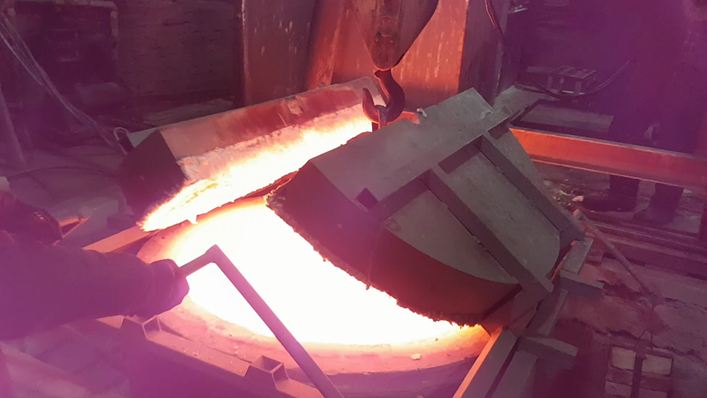
Treatment objectives and results
Austenitisation makes it possible to:
- obtain a uniform austenitic structure;
- improve the mechanical properties of steel, particularly its ductility and toughness;
- reduce residual welding stresses by 70–80%;
- prevent carbide precipitation;
- improve the corrosion resistance of the welded joint.
Where austenitisation is used
Austenitisation is applied to welded joints in steam pipelines made of heat-resistant, high-alloy austenitic steels.
This heat treatment is particularly important for equipment operating under pressure and at high temperatures, where stringent requirements are imposed on the reliability of welded joints.
Why austenitisation is important
Without austenitisation, residual stresses and a non-uniform structure may remain in the weld area. Over time, this can lead to cracking and failure of the joint.
Properly performed austenitic quenching extends the service life of steam pipelines and ensures stable equipment operation under demanding operating conditions.