

Steel Normalization

Normalizing
Steel normalization is an important metallurgical process that significantly improves the quality and properties of metal products. This heat-treatment method helps achieve a uniform microstructure, improve mechanical properties and relieve internal stresses
What normalization is and why it is performed
Normalization is a technological operation aimed at improving the structural and physical-mechanical properties of metal products. The process involves heating the metal to a temperature 30–50 °C above the upper critical point Ac3 (typically 800–950 °C for carbon steels), holding it at that temperature, and then cooling it in air. It is used mainly for steel, and also for cast iron and copper alloys.
The goal of normalization is to obtain a uniform, fine-grained structure that relieves internal stresses caused by casting, forging or welding, improves machinability and increases strength. Hardness, toughness, elasticity and fatigue strength are all improved. Normalization is especially important for high-carbon and alloy steels and prepares the metal for further operations such as hardening and tempering. Holding time depends on composition and part size (from a few minutes to several hours); the key is achieving full austenitization. Cooling rate affects the structure: faster cooling produces a finer grain, but excessively fast cooling can cause residual stresses that require subsequent tempering.
The objectives of normalization:
- improving the microstructure of the steel;
- increasing mechanical properties and preparing for subsequent heat treatment;
- correcting the structure after forging and stamping of parts;
- removing overheating after welding and relieving stresses in the weld seam;
- increasing yield strength, tensile strength and impact toughness in castings.
For some grades of carbon and special steels, normalization is the final heat-treatment operation, as the steel acquires the required properties.
Equipment
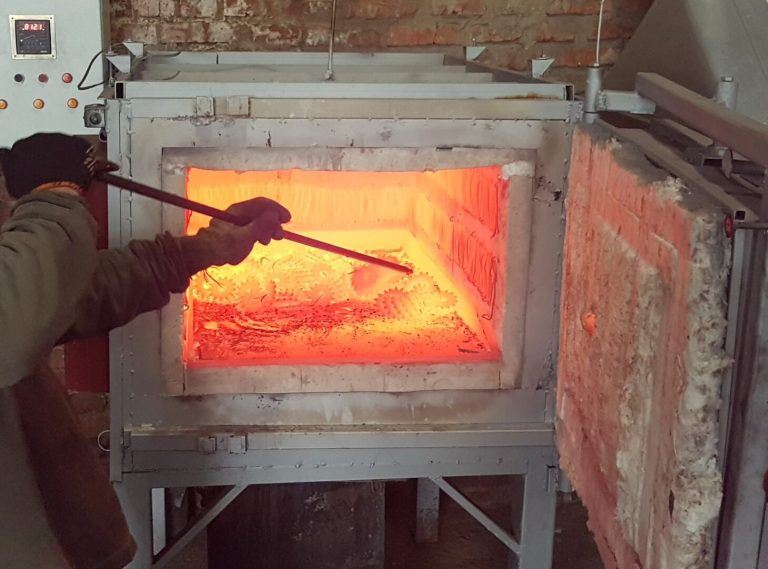
Normalization accuracy is ensured by industrial furnaces: chamber furnaces (for large batches, with capacities up to several tonnes and working temperatures up to 1200 °C), pit furnaces (for long products such as bars and tubes) and continuous (conveyor) furnaces for non-stop processing at large plants. Main components: temperature control systems, heating elements (electric resistors, gas burners or induction heating), insulation materials, and ventilation and cooling systems.
Performing the work
- Preparation and loading. Inspection and preparation of products, removal of contaminants, scale and rust; even distribution in the furnace for good heat circulation.
- Heating. For carbon steels 800–920 °C depending on composition; for alloy steels the range is wider.
- Holding. From a few minutes to several hours — for full heating and austenitization.
- Cooling. In air, evenly, to avoid internal stresses; cooling rate determines the phase composition and properties.
- Quality control. Hardness measurement, metallographic examination and, if necessary, mechanical tests (tensile, impact toughness).
Normalization specifics for different steel grades
- Carbon steels (10, 20, 45). Temperature 30–50 °C above Ac3: for low-carbon (up to 0.25%) about 900 °C, for higher carbon (about 0.6%) — up to 920 °C and above.
- Alloy steels (Cr, Ni, Mo, V). Require higher temperatures and longer holding; alloying elements slow phase transformations. For example, chromium-molybdenum grades (35HM, 12HM) — 930–980 °C.
- Tool steels (U8, U10A, X12M). Strict temperature control to avoid grain growth and preserve properties.
- High-strength low-alloy steels (09G2S). Normalization at 860–900 °C for an optimal combination of strength and ductility.
Parameters (temperature, holding time, cooling rate) are selected based on the steel’s chemical composition, prior processing and required properties, taking into account the formation of ferrite, pearlite, bainite and martensite.
KARBAZ performs normalization of steel grades 20, 40H, 45 and metal structures in temperature-controlled furnaces — relieving internal stresses and refining the metal structure. Delivery across Ukraine and the EU.