
What Is Local Heat Treatment?
Local heat treatment is the heat treatment of a specific area of a component or a welded joint zone without heating the entire item. This approach makes it possible to relieve residual stresses, improve the metal structure and enhance the service properties of welded structures. The method is indispensable when full furnace heat treatment is impossible — for example, during repair work or directly on site.
It is widely used in the power generation, oil and gas, chemical and mechanical engineering industries. Typical components treated include pipes, flanges, housings, welded assemblies and other metal elements subjected to thermomechanical loads.
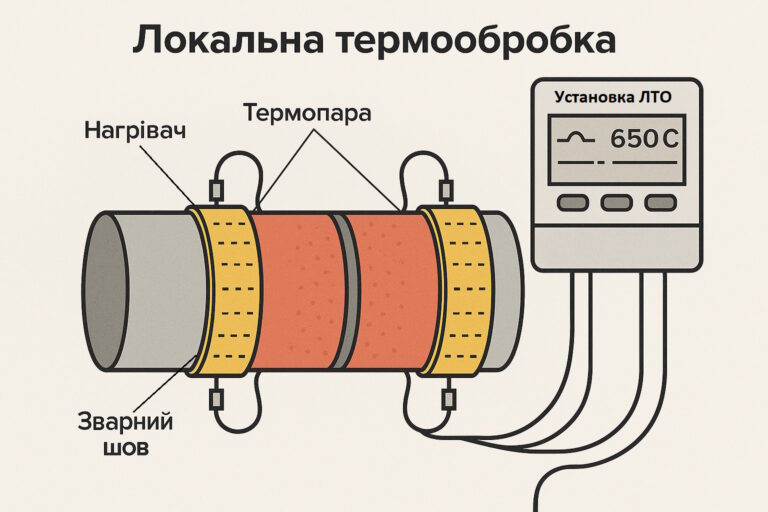
Main Objectives of Local Heat Treatment
- Post-weld stress relief (Post Weld Heat Treatment, PWHT)
- Normalizing or tempering of steel
- Prevention of cracking
- Improvement of the heat-affected zone (HAZ) microstructure
- Restoration of the mechanical properties of the metal
Standard Treatment Cycle
- Heating at a rate of 50–150 °C/h to the specified temperature
- Holding at the target temperature depending on the metal thickness
- Controlled cooling to 300 °C, followed by slow cooling in still air

Advantages of Local Heat Treatment
- Mobility: work is carried out directly on site
- Energy efficiency: only the required area is heated
- Precision: minimal distortion of structures
- Cost efficiency: significant savings compared with full furnace heating
Our Technical Capabilities
Our Technical Capabilities
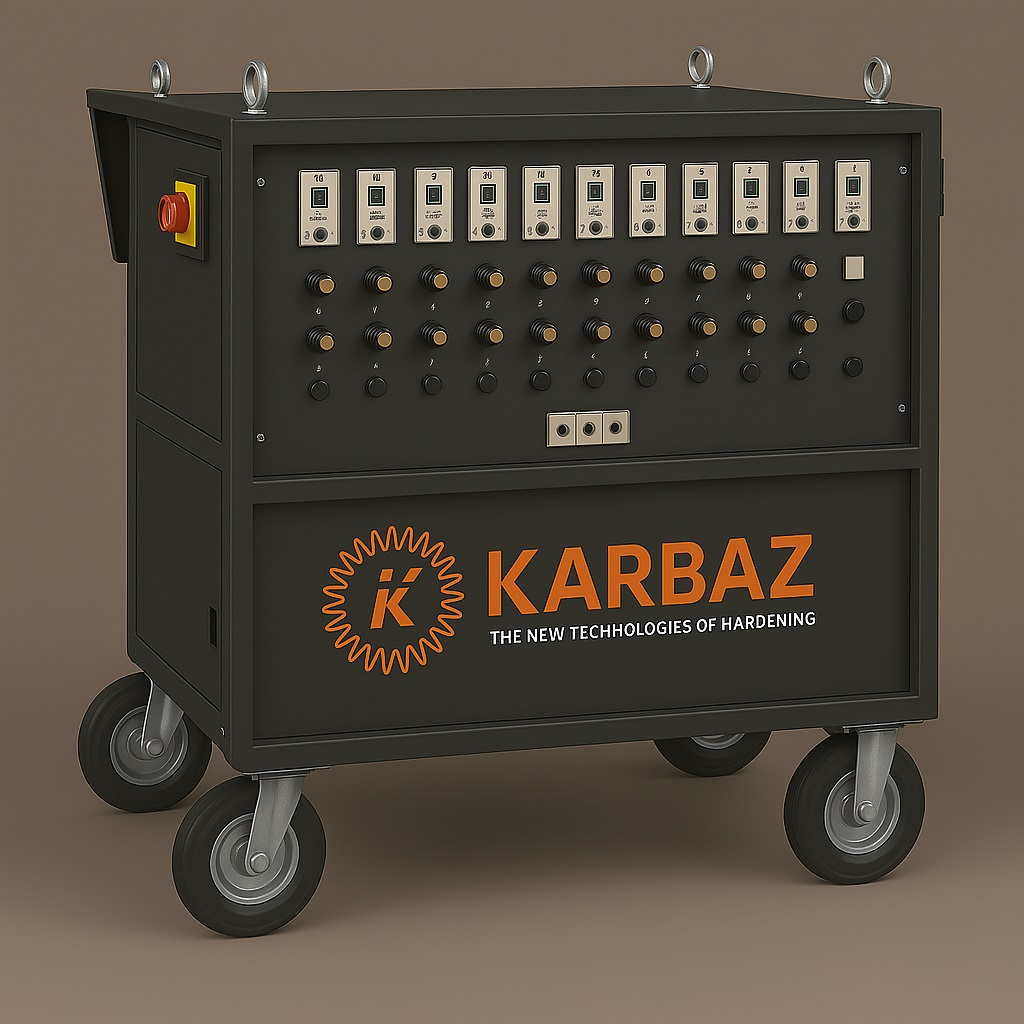
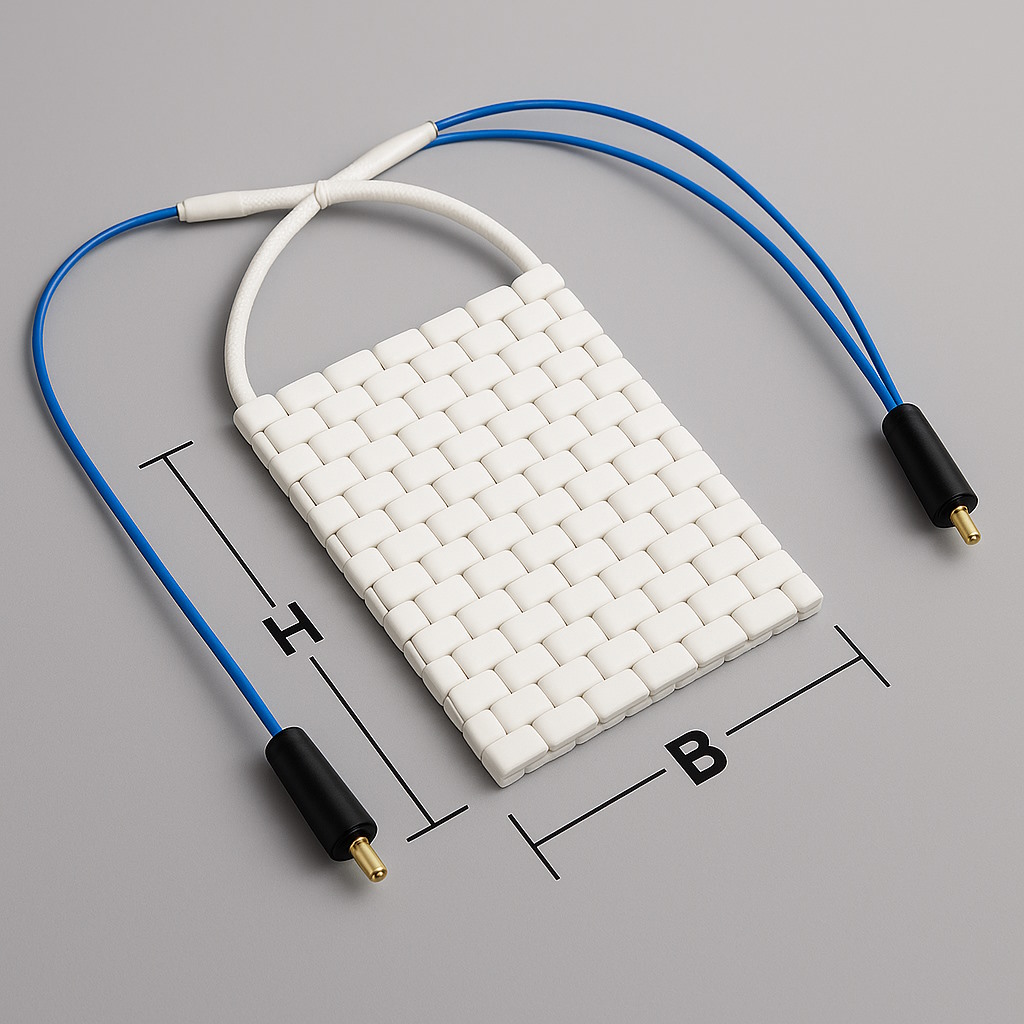
We use a 20 kW local heating unit that allows up to 9 heating elements to be connected simultaneously. Each of the three independent channels supports up to three elements with individual temperature control.
The heaters are ceramic pad heaters made of alumina ceramic (96% Al₂O₃) with NiCr 80/20 heating wire. They withstand temperatures up to 1050 °C and up to 70 heating cycles at 760 °C, ensuring stable operation even under intensive use.
For complex geometries, we use heating tapes and flexible heating cables up to 5.3 m long, which allow heat treatment of pipes, flanges, elbows and other components.
The unit operates at a voltage of 30–60 V and a current of up to 500 A — safe, efficient and reliable.
We use a 20 kW local heating unit that allows up to 9 heating elements to be connected simultaneously.
Each of the three independent channels supports up to three elements with individual temperature control.
The heaters are ceramic pad heaters made of alumina ceramic (96% Al₂O₃) with NiCr 80/20 heating wire. They withstand temperatures up to 1050 °C and up to 70 heating cycles at 760 °C, ensuring stable operation even under intensive use.
The heaters are ceramic pad heaters made of alumina ceramic (96% Al₂O₃) with NiCr 80/20 heating wire. They withstand temperatures up to 1050 °C and up to 70 heating cycles at 760 °C, ensuring stable operation even under intensive use.
For complex geometries, we use heating tapes and flexible heating cables up to 5.3 m long, which allow heat treatment of pipes, flanges, elbows and other components. The unit operates at a voltage of 30–60 V and a current of up to 500 A — safe, efficient and reliable.
Time and cost savings. No need to transport the item — the entire process takes place on site.
Control and precision. The equipment allows the temperature profile to be monitored in real time.
Minimal heat input. Only the required zone is heated, which eliminates overheating and distortion of the entire part.
Longer service life. Structure stabilization and stress relief increase the durability of metal structures.
Versatile application. The method is suitable for carbon and alloy steels, cast iron and non-ferrous metals.
Typical Tasks and Examples
of Local Heat Treatment
Post-Weld Stress Relief (PWHT)
- Treatment of girth welds on Ø273 mm pressure pipes after welding — 2 heating zones, temperature monitoring, charts.
- PWHT of DN200 flanges in the vertical position — heating from both sides with thermocouples at 6 points.
Closure Weld Treatment
- Local treatment of a closure joint on a Ø426 mm trunk pipeline.
- Closure weld of a 60 m³ tank — treatment of the final joint after welding the head.
Restoration After Repair
- Local repair and treatment of a 700 mm long insert in a Ø219 mm pipe.
- Treatment of the area next to a weld joint after ultrasonic testing (UT) for defects.
Thick-Walled Components
and Non-Standard Geometry
- PWHT of a Ø520 mm flange, 65 mm thick, with three heating zones.
- Heat treatment of a nozzle welded to a tank wall (90° bend + difficult access).
Large Structures — Safe Treatment Without Dismantling
- Treatment of corner joints of a 3×7 m heat exchanger at a chemical plant.
- Local treatment of bottom-to-shell joints of a Ø12 m tank.
Preheating Before Welding
- Preheating of a Ø159 mm pipe joint before welding at an ambient temperature of −8 °C.
- Preheating of a 15KhM (13CrMo4-5) steel structure during installation — up to 250 °C, 4 heating elements.
Controlled Cooling After Welding or Heat Treatment
- Cooling of a weld on a Ø324 mm pipe after PWHT at a combined heat and power (CHP) plant.
- Controlled cooling after heating a steam pipeline assembly in a boiler house.
Local Stress Relief After Mechanical Work
- Treatment of a section of a pump unit housing after mechanical repair.
- Equalization of the temperature field in the straightening zone of a bearing bracket.
Contact us for a consultation
and a quote for on-site local heat treatment